




Next 17th My event
Login

Lean Six Sigma Green and Black Belt Certification

Lean Six Sigma Green and Black Belt Certification

At a Glance: Course + Exam Overview

Category Lean Six Sigma
Program Name Lean Six Sigma Green and Black Belt Certification

Lean Six Sigma Green Belt & Black Belt Certification Course

Are you ready to take on leadership roles? Welcome to the Anexas Lean Six Sigma Green Belt and Black Belt certification course. Lean Six Sigma consists of a proven methodology that improves processes, reduces waste, increases customer satisfaction, and improves profitability. Lean Six Sigma Green Belts and Black Belts imbibe skills that can effectively shift the working structure of a company for the better, with anybody from any background being able to take this course to cause such shifts and advance their careers.

Anexas Lean Six Sigma Green Belt Certification course trains in techniques to improve the quality and consistency of products and services. Anexas Lean Six Sigma Black Belt Certification course upskills leadership skills to prepare people for managerial or leadership roles, contributing directly to a business’s success. Anexas has trained more than 75,000 Green Belts and 25,000 Black Belts worldwide.

The Lean Six Sigma Green Belt and Black Belt course is a combination of Green Belt and Black Belt courses that enables professionals to take the courses together hassle-free and get certified in less time. The certification course provides two independent certifications. Lean Six Sigma Green and Black Belt course is a 6-day course, 3 days for each course.

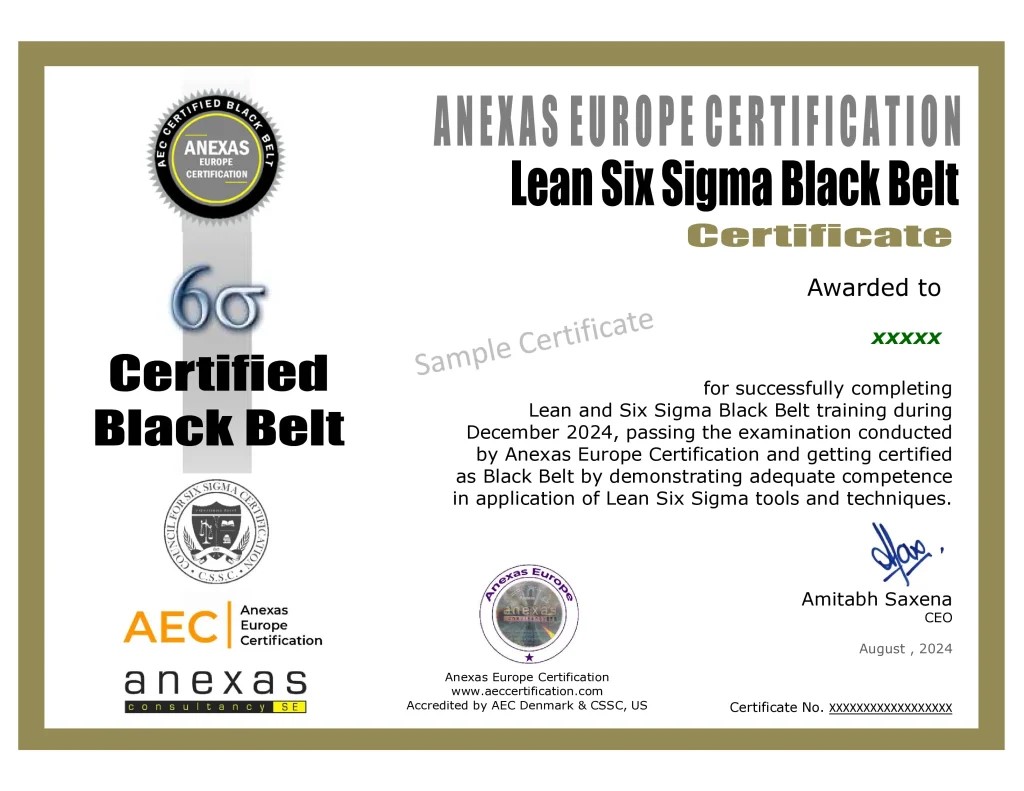
Certifications you will receive:

What you'll gain:

Download Brochure

Course Outline

  • Introduction to class
  • Introduction to Anexas


  • Course purpose & objectives
  • What is Six Sigma
  • History of Six Sigma


  • Estimating process sigma
  • Understanding Variation


  • Overview of DMAIC
  • Overview of DMADV
  • Case study
  • DMAIC storyboard template


  • Project Selection Criteria
  • Team charter
  • Project Charter
  • Elements of Project Charter


  • Quality, systems, and processes
  • Work as a process


  • What is VOC and importance
  • Defining the customers
  • VOC data collection plan
  • Reactive/proactive data collection systems
  • Analyzing customer data – affinity diagram


  • Kano model
  • Defining CTQs
  • Setting specifications for CTQs
  • VOC data collection plan


  • Understanding Processes
  • SIPOC
  • Examples on SIPOC


Define Phase

  • Basic statistics and introduction to Minitab
  • Normal distribution
  • Mean and standard deviation
  • P-values


  • How data can help
  • Data characteristics
  • Five-step data collection process
  • Step 1: Clarify Data Collection Goals
    • Stratifying data
    • Types of data
  • Step 2: Develop Operational Definitions and Procedures
    • Operational definitions
    • Sampling approaches
    • Determining sample size
    • Population versus process samplingChecksheets
  • Step 3: Validate the Measurement System
    • Problems with measurement
    • Desired measurement characteristics for continuous variables
    • Gage R&R study
    • Gage linearity study
    • Checking a measurement system for discrete data


  • Time-ordered data
  • Understanding variation
  • Variation versus specifications
  • Taguchi Loss Function
  • Types of variation, appropriate responses
  • Special cause, common cause
  • Plots of variation
  • Control charts
  • Specifications and control limits


  • Develop a focused problem statement
  • Identify potential causes
  • Brainstorming, Five Whys
  • Understand relationships between potential causes
  • Might-cause check
  • Cause-and-effect diagram
  • Tree diagram
  • Prioritizing Input Variables


  • Verifying cause-and-effect data
  • Histograms
  • Scatter plots
  • Pareto Charts
  • Box Plots


  • Process maps
  • Identifying Value-Added path
  • VA/NVA analysis
  • Identifying flow issues


  • 8 wastes
  • Cycle time
  • Bottlenecks
  • Value Stream Mapping (VSM)


  • Involving people
  • Lean solutions
  • Generating solution alternatives
  • Evaluating solutions
  • Prioritization matrix, Pugh matrix
  • Task and timeline planning
  • Budget and resource planning
  • Planning for change
  • Planning to check
  • Potential problem analysis
  • Piloting
  • Implementing the plans


  • Quantifying results
  • Evaluation and reactions


  • Link improvement to management system
  • Methods for monitoring and control
  • Ongoing data collection, process control
  • Variation and individuals charts
  • Control charts for high-volume processes with subgroups: x bar and r charts
  • Control charts for discrete data: p, np, c, and u charts


  • Project closure
  • Closure checklist


Key Benefits of Lean Six Sigma Green Belt and Black Belt

Finish the course and get certified